

Arc flash safety is a critical topic that every electrical worker and facility manager must prioritize to prevent devastating injuries and costly damages. Understanding the dangers of arc flashes, recognizing the risks in your workplace, and implementing proper safety measures can save lives and ensure compliance with industry standards.
What is Arc Flash?
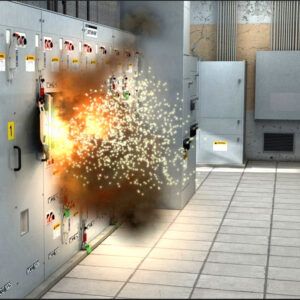
An arc flash is the intense light and heat generated by an arc flash explosion. Temperatures during an arc flash can soar between 5,000 and 35,000 °F, hot enough to ignite clothing and cause severe burns to anyone standing just a few feet away. Beyond the immediate fire hazard, an arc flash can melt metal, cause serious lung and eye injuries, and in extreme cases, result in hospitalization or even death.
Additionally, arc flashes can cause flying objects, blast pressure, and sound blast.
What Causes an Arc Flash to Occur?
One of the primary causes of arc flash incidents is voltage transients, which occur during the switching of reactive loads or as a result of lightning strikes. Although these transients may last only microseconds, they can carry thousands of amps of electrical energy, creating a significant hazard. Aside from voltage transients, there are other factors that can cause an arc flash to occur, including:
- Worn or loose connections
- Insulation failure or damaged equipment
- Touching a test probe to the wrong surface
- Gaps in insulation
- Improperly installed parts
- Dust
- And, corrosion
Preventing Arc Flashes
Controlled measures can be adopted to reduce both the hazard and likelihood of an arc flash. Control measures that can help reduce the risks include:
- De-energize electrical equipment
- Wear appropriate PPE
- Maintain safe distances
- Perform risk assessments
- And, provide or receive proper training
Boundaries
Workers should always follow the National Fire Protection Association's (NFPA) Arc Flash Approach and Protection Boundaries. These boundaries are designed to protect those working on or near energized equipment. These boundaries include:
- Flash Protection Boundary - Outer boundary exposed to heat and the risk of second-degree burns
- Limited Approach Boundary - Energized part where there is a shock risk
- Restricted Approach Boundary - Energized part where there is an increased shock hazard
- And, Prohibited Approach Boundary - Inner boundary which represents distance from exposed parts equivalent of making direct contact
**Boundaries may vary by device and are determined by voltage**
Lockout/Tagout
Lockout/tagout procedures play a vital role in minimizing risks during electrical equipment maintenance. Only authorized personnel are allowed to apply tagout devices, which must be securely attached in a way that clearly indicates the energy-isolating devices must not be moved from the “safe” or “off” position. If it’s not possible to attach a tag directly to the energy-isolating device, the tag should be placed as close as safely possible to the device. Additionally, the tag must be highly visible to anyone attempting to operate the equipment, ensuring clear communication of the hazard.
Warning Labels
Evaluate any equipment operating at 50 volts or higher that hasn’t been de-energized for arc flash and shock protection. After completing the evaluation, print and affix warning labels to the equipment. Warning labels can indicate different hazards, including:
- Level of Personal Protective Equipment (PPE) required
- Flash hazard boundary
- Flash hazards
- Shock hazards
- And, approach distances
Protection Methods
An effective way to protect workers, both qualified and non-qualified, while operating electric equipment, is to implement protection methods throughout the workplace, such as:
- Ground Fault Circuit Interrupters (GFCIs)
- Insulated tools
- Grounding tools
- And, barricades
Additionally, workers must wear arc flash rated Personal Protective Equipment (PPE) when working with electrical equipment, including:
- Goggles
- Face shields
- Helmets
- Flame resistant clothing
- Insulated gloves
- And, shoes/boots without metal pieces
Resources
OSHA provides information on Electric-Arc Flash Hazard and a PDF for Protecting Employees.
Conclusion
Arc flash remains one of the most dangerous hazards workers can face in electrical environments, making safety awareness and proper precautions absolutely essential. By understanding the risks, using the right personal protective equipment (PPE), and following established safety protocols, workers can significantly reduce the likelihood of injury or fatality.

Brooklyn Nice
Brooklyn Nice is a Content Development Specialist at JJ Safety, where she creates engaging, OSHA-focused safety content, training materials, and educational resources for workers and employers. She has earned her OSHA 10 Certification, providing her with a strong foundation in workplace safety principles and industry best practices.