
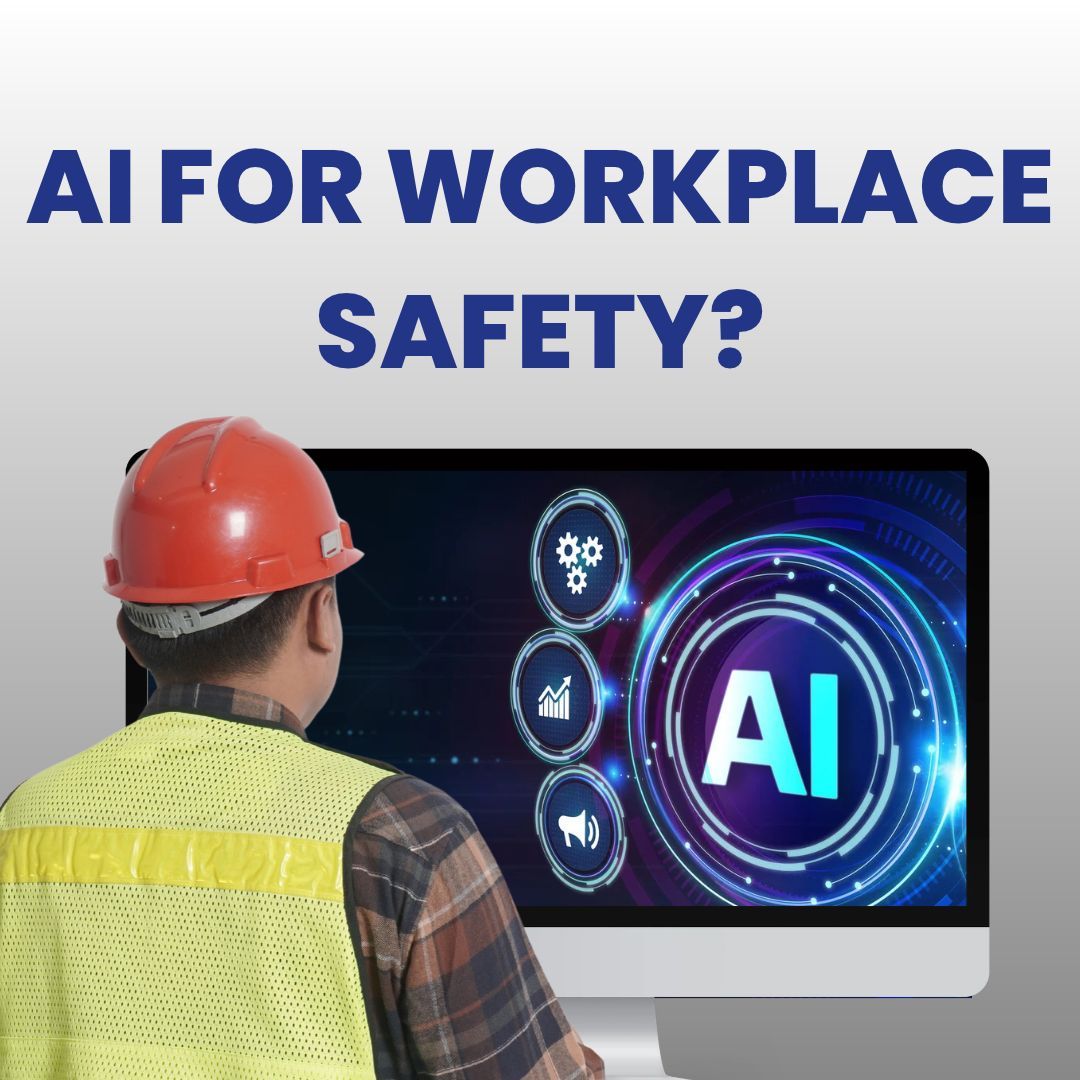
What if your safety program could identify a serious risk before the incident happened?
For years, workplace safety has relied on incident reports, inspections, training, and lessons learned from past injuries. These tools remain essential, but what if companies could use that information to recognize warning signs before an incident occurs?
Artificial Intelligence (AI) and predictive analytics are creating new opportunities to approach workplace safety more proactively. By analyzing patterns in safety data, these technologies may help employers identify recurring hazards, recognize potential risks, and make more informed decisions about where preventive action is needed.
This isn't just a conversation about future technology. The Occupational Safety and Health Administration (OSHA) has begun discussing how emerging technologies, including AI and predictive analytics, could help employers recognize serious risks earlier and prevent severe injuries and fatalities.
So, can predictive analytics prevent workplace injuries? The potential is promising, but the real value depends on how companies use the technology and whether they turn the information into meaningful safety improvements.
What Is Predictive Analytics in Workplace Safety?
Predictive analytics uses data, statistical methods, and analytical models to identify patterns and estimate where risks may exist. AI can support this process by analyzing large amounts of information and identifying relationships that might be difficult to recognize through a manual review alone.
In workplace safety, that information might include:
- Injury and illness reports
- Near-miss reports and incident investigations
- Workplace inspection findings
- Hazard observations and corrective actions
- Equipment maintenance records
- Training records and competency information
- Environmental conditions and exposure data
- And, trends in specific tasks, work areas, or types of equipment
For example, imagine a construction company reviewing several months of safety reports. The reports might reveal repeated near misses involving backing equipment, recurring housekeeping issues in the same work areas, or similar hazards during a particular phase of a project.
An AI-powered system could help identify those patterns and flag areas that deserve closer attention. Instead of treating each report as an isolated event, safety teams could use the combined information to investigate underlying problems and prioritize preventive measures.
The goal isn't to predict every accident with certainty. It's to make better use of the warning signs that already exist.
How Is OSHA Approaching AI and Workplace Safety?
OSHA's interest in this area makes the topic especially relevant for employers and safety professionals.
In remarks delivered at the National Safety Council's Safety Congress & Expo on September 15, 2026, OSHA discussed the growing use of automation, robotics, artificial intelligence, and digital systems in the workplace.
The agency highlighted the potential for technology to help employers understand how workers, equipment, and organizations interact and to recognize patterns that may indicate developing serious risks.
OSHA also discussed the value of using high-severity exposures, near misses, and other leading indicators to identify where a serious incident could occur before someone gets hurt.
The remarks connected this approach with broader efforts to prevent severe injuries and fatalities, including work with safety organizations on education and practical prevention strategies.
You can read OSHA's remarks here: https://www.osha.gov/news/speeches/20260915
This is an important distinction: OSHA's discussion highlights the potential of emerging technology and data-driven prevention. It does not mean AI is guaranteed to prevent injuries, or that using AI automatically satisfies an employer's safety obligations.
The underlying principle remains the same, identify hazards, evaluate risks, and take effective action to control them.
Can Predictive Analytics Help Prevent Workplace Injuries?
Predictive analytics may help safety teams move beyond reacting to incidents and toward recognizing conditions that could lead to future harm.
Here are four ways it could support a more proactive safety program.
1. Identifying Patterns in Near Misses
Near misses can provide valuable information about hazards that have not yet resulted in an injury.
However, that information is only useful if companies report, review, and learn from it.
AI tools may help organize near-miss reports, identify recurring circumstances, and highlight common factors across multiple incidents. For example, reports involving workers and moving equipment might reveal a recurring communication problem or a lack of separation between pedestrian and vehicle traffic.
Recognizing that pattern gives the safety team an opportunity to review work practices, improve traffic controls, and address the hazard before a more serious event occurs.
OSHA encourages employers to investigate close calls because they can reveal hazards and weaknesses in safety programs. Learn more through https://www.osha.gov/incident-investigation
2. Recognizing Recurring Hazards During Inspections
Workplace inspections generate information about unsafe conditions, damaged equipment, missing safeguards, housekeeping issues, and other potential hazards.
When inspection findings are reviewed individually, it can be difficult to see the bigger picture. Predictive analytics may help compare findings over time and identify locations, tasks, or hazard categories that repeatedly require corrective action.
For example, if inspections repeatedly identify inadequate fall protection controls on certain projects, the trend may indicate a broader issue involving planning, training, supervision, or equipment availability.
The important next step is investigating why the issue keeps appearing, not simply counting how often it happens.
OSHA's Hazard Identification and Assessment guidance recommends reviewing inspection findings, investigating incidents and near misses, and identifying trends in reported hazards.
3. Prioritizing Serious Risks
Not every hazard carries the same potential consequences. Safety teams need to identify which conditions require immediate attention and which corrective actions will provide the greatest protection.
AI-assisted analysis may help organize information according to factors such as potential severity, exposure frequency, repeated findings, and the effectiveness of existing controls.
Consider a workplace where reports identify several minor housekeeping issues alongside a hazard involving unprotected exposure to moving machinery. A useful system should help direct attention toward the potential for serious harm rather than simply ranking hazards by how frequently they appear.
Any prioritization system must be designed and reviewed carefully. A hazard should not be considered acceptable just because a model assigns it a low risk score.
The purpose of the technology is to support informed decisions, not to replace professional judgment or delay action on serious hazards.
4. Supporting Better Safety Decisions
Safety professionals often have to make decisions using information spread across multiple reports, spreadsheets, inspection forms, and company systems.
AI tools may help summarize that information, identify changes over time, and highlight areas that deserve further investigation.
For example, a safety team might use data to determine whether recurring findings are connected to a specific work activity, location, equipment type, or training need.
The team can then evaluate whether existing controls are working, involve workers who understand the task, and decide what changes are necessary.
OSHA's guidance on leading indicators explains how proactive measures can help employers evaluate safety activities and identify potential problems before injuries occur.
AI may make some of that analysis faster, but the objective is still to take effective preventive action.
What Are the Limitations of AI in Workplace Safety?
AI can be a useful tool, but it is not a substitute for a strong safety program. Employers should understand several important limitations before relying on it.
Poor data can lead to poor conclusions. If incident reports are incomplete, inspection findings are inconsistent, or workers are reluctant to report near misses, an AI system may miss important patterns or draw misleading conclusions.
Not every risk can be predicted. Unexpected equipment failures, changing work conditions, human factors, and unusual events may not resemble anything in the historical data. A system that identifies yesterday's patterns may still miss tomorrow's hazard.
Bias can affect the results. If certain work groups report hazards less frequently or some types of incidents are underrepresented, the system may underestimate risks in those areas.
Technology can also create privacy concerns. Tools that collect worker location, video, performance, or other personal information should be evaluated for privacy, transparency, appropriate access, and potential misuse.
Predictions do not eliminate hazards. Identifying a potential problem is only the beginning. Employers still need to evaluate the risk, implement effective controls, verify that those controls work, and make adjustments when necessary.
AI should strengthen safety decisions, not create a false sense of security.
How Can Companies Start Using AI in Their Safety Programs?
Companies do not necessarily need an advanced AI platform to begin improving how they use safety data. The most important first step is establishing a consistent process for collecting information, recognizing hazards, and following through on corrective actions.
Here are 5 practical steps to consider:
- Review your existing safety data: Determine whether incident reports, near misses, inspections, training records, and corrective actions are documented consistently.
- Look for recurring problems: Start by identifying repeated hazards, common causes of incidents, and corrective actions that remain incomplete.
- Prioritize hazards based on risk: Consider the potential severity of an incident, the likelihood of exposure, and the effectiveness of existing safeguards.
- Evaluate technology carefully: If an AI tool is introduced, assess its accuracy, limitations, data requirements, privacy implications, and suitability for your operations.
- And, turn findings into action: Involve workers and supervisors, implement appropriate controls, assign responsibility for corrective actions, and verify that the changes are effective.
These steps align with OSHA's broader approach to proactive hazard identification and prevention. Technology can support the process, but it cannot replace management commitment, worker participation, or accountability.
The Future of Workplace Safety Is Proactive
Artificial intelligence and predictive analytics may become increasingly valuable tools for workplace safety. They offer opportunities to recognize patterns, organize information, and identify warning signs that could otherwise go unnoticed.
But technology alone will not prevent injuries. A company can have sophisticated software and still struggle with incomplete reporting, ineffective training, unresolved hazards, or a culture that prioritizes production over safety. The real benefit comes when useful information leads to better decisions and meaningful changes in the workplace.
OSHA's recent discussion of emerging technologies reinforces the importance of identifying serious risks earlier and learning from near misses and other leading indicators.
For employers, the opportunity is to combine those insights with the fundamentals of effective safety management: recognize hazards, evaluate risks, implement controls, and continuously improve.
The most effective safety program isn't one that simply explains what went wrong. It's one that uses every available tool to help identify what could go wrong and takes action before someone gets hurt.

Brooklyn Nice
Brooklyn Nice is a Content Development Specialist at JJ Safety, where she creates engaging, OSHA-focused safety content, training materials, and educational resources for workers and employers. She has earned her OSHA 10 Certification, providing her with a strong foundation in workplace safety principles and industry best practices.