

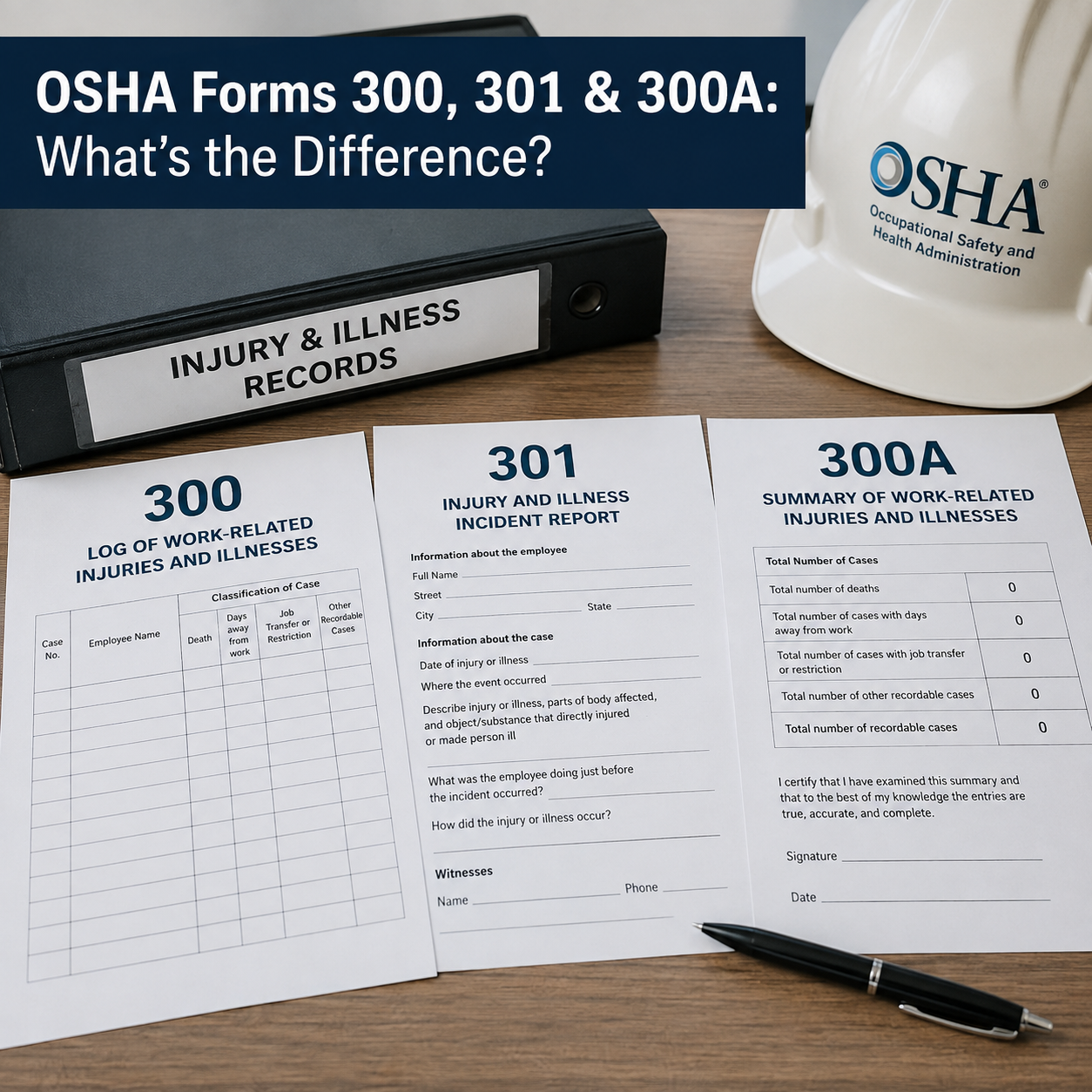
If your business has ever gone through an OSHA inspection, contractor prequalification, or internal safety audit, you’ve likely been asked for your OSHA injury and illness records. These records are built around three key forms that often get confused: the OSHA Form 300, OSHA Form 300A, and OSHA Form 301.
Although they are closely related, each form serves a distinct purpose in OSHA’s recordkeeping system. Together, they provide a complete picture of workplace safety performance and help employers track, analyze, and prevent injuries and illnesses.
This ultimate guide breaks down everything you need to know about OSHA forms, including what each one does, how they work together, what must be recorded, and how to stay compliant with OSHA’s requirements.
What Are OSHA Recordkeeping Forms?
Under OSHA’s Recordkeeping Rule (29 CFR Part 1904), covered employers are required to track certain work-related injuries and illnesses. Most employers with 10 or more employees must maintain OSHA injury and illness records unless they fall under specific low-risk industry exemptions.
The OSHA system uses 3 primary forms, such as:
- OSHA Form 300 – Log of Work-Related Injuries and Illnesses
- OSHA Form 300A – Summary of Work-Related Injuries and Illnesses
- And, OSHA Form 301 – Injury and Illness Incident Report
Each form plays a different role, but together they create a complete documentation system for workplace incidents.
OSHA Form 300: The Master Injury Record
The OSHA Form 300, or OSHA 300 Log, is the foundation of OSHA recordkeeping. It is a running log that tracks every recordable work-related injury or illness that occurs during the calendar year.
Think of it as your official injury and illness ledger. Each qualifying incident is entered as a separate line item.
For every recordable case, employers must document:
- Employee name (unless it is a privacy case)
- Job title
- Date of injury or illness
- Where the incident occurred
- Description of the injury or illness
- Case classification (death, days away from work, restricted work/job transfer, or other recordable case)
- Number of days away from work
- Number of restricted or transferred workdays
- And, type of injury or illness
The OSHA Form 300 is updated continuously throughout the year as new recordable cases occur.
OSHA 301 Incident Report: The Detailed Case File
While the OSHA Form 300 provides a summary of each case, the OSHA 301 Incident Report delivers the full story behind every recordable injury or illness.
For each entry on the OSHA Form 300, employers must complete an OSHA 301 form or an equivalent form containing the same required information.
The OSHA 301 Form includes detailed information, such as:
- Employee name, job title, and department
- Date and time of the incident
- Exact location of the incident
- Description of what the employee was doing at the time
- How the injury or illness occurred
- Object, substance, or exposure that caused the incident
- Type of medical treatment provided
- And, the name of the healthcare provider, if applicable
The OSHA 301 Form serves as the “case narrative,” explaining how and why each incident happened. It must be completed within 7 calendar days of learning that a recordable case has occurred.
OSHA 300A Summary: The Annual Overview
The OSHA 300A Annual Summary is very different from the other two forms. It does not contain individual case details.
Instead, it provides a high-level summary of all recordable injuries and illnesses from the OSHA 300 Form for the previous calendar year.
The OSHA 300A includes:
- Total number of deaths
- Total cases with days away from work
- Total cases with job transfer or restriction
- Total other recordable cases
- Total days away from work
- Total restricted or transferred workdays
- Injury and illness totals by category
- Average number of employees
- And, total hours worked during the year
Unlike the OSHA 300 Form and 301, the OSHA 300A does not include employee names or incident descriptions.
How the Three OSHA Forms Work Together
Each OSHA form plays a specific role in the recordkeeping process.
OSHA 300 Form:
- Tracks all recordable cases in a running log
- Updated throughout the year
- Incudes basic case information
- Used for ongoing tracking
OSHA 301 Incident Report:
- Provides detailed documentation for each case
- Completed for each individual incident
- Includes full narrative and cause of injury
- Used for investigations and documentation
OSHA 300A Summary:
- Summarizes yearly totals from the OSHA 300 Form
- Completed once a year
- Includes only totals and summary data
- Used for annual reporting and posting
Together, these forms ensure OSHA has both detailed incident data and a clear annual overview of workplace safety performance.
What Is a Recordable Injury or Illness?
Not every workplace injury must be recorded on OSHA forms. A case is generally recordable if it is work-related and results in one or more of the following:
- Death
- Days away from work
- Restricted work or job transfer
- Medical treatment beyond first aid
- Loss of consciousness
- Or, a significant injury or illness diagnosed by a licensed healthcare professional
OSHA also requires recording for specific cases such as:
- Needlestick and sharps injuries
- Occupational hearing loss
- Medical removal cases
- Work-related tuberculosis
Before recording a case, employers should confirm:
- Did an injury or illness occur?
- Was it work-related?
- Is it a new case?
- Does it meet OSHA’s recording criteria?
If all four conditions are met, the case must be recorded.
First Aid vs. Medical Treatment
One of the most common areas of confusion in OSHA recordkeeping is the difference between first aid and medical treatment.
In general:
- First aid cases are not recordable
- Medical treatment beyond first aid is recordable
OSHA provides a specific list of treatments considered first aid, such as basic wound care or over-the-counter medications in limited circumstances.
If treatment goes beyond first aid and the case meets other criteria, it must be recorded on the OSHA 300 form and documented with an OSHA 301 form.
How to Record an OSHA Case
Once an employer determines that a case is recordable, OSHA requires:
- Entry on the OSHA 300 Form
- Completion of the OSHA 301 Incident Report
Both must be completed within seven calendar days of learning about the recordable incident.
If new information becomes available later (for example, an injury initially requiring medical treatment later results in days away from work), the OSHA 300 Form must be updated to reflect the final outcome.
OSHA 300A Posting Requirements
The OSHA 300A Summary has a unique requirement: it must be posted for employees to see.
Each year, employers who are required to maintain OSHA records must:
- Review the OSHA 300 form for accuracy
- Complete the OSHA 300A Summary
- Have a company executive certify the form
- Post the OSHA 300A in a visible workplace location from February 1 through April 30
Even if no recordable injuries or illnesses occurred, a “zero case” OSHA 300A must still be completed and posted if the employer is required to keep OSHA records.
How Long OSHA Forms Must Be Kept
Employers must retain OSHA recordkeeping forms for five years following the end of the calendar year they cover. This includes:
- OSHA 300 Form
- OSHA 300A Summary
- OSHA 301 Incident Reports
- Privacy case list (if applicable)
During this retention period, the OSHA 300 form must be updated if:
- A previously unrecorded recordable case is discovered, or
- New information changes the classification of an existing case
The OSHA 300A and OSHA 301 forms generally do not require updates after completion.
Do OSHA Forms Need to Be Submitted?
Most employers are not required to submit OSHA forms directly to OSHA.
However, certain employers must electronically submit injury and illness data through OSHA’s Injury Tracking Application (ITA). Requirements depend on factors such as:
- Industry classification
- Establishment size
- OSHA reporting rules for that year
Even when electronic submission is required, employers must still maintain the original OSHA 300, 300A, and 301 records internally.
Why OSHA Recordkeeping Matters
Accurate OSHA recordkeeping is more than a compliance requirement, it is a powerful safety tool.
Properly maintained OSHA forms help employers:
- Identify injury trends and hazards
- Improve workplace safety programs
- Support contractor prequalification and bidding
- Prepare for OSHA inspections and audits
- Reduce future incidents through data-driven prevention
Inaccurate or incomplete records can lead to compliance issues, OSHA citations, and missed opportunities to improve workplace safety.
Conclusion
The OSHA 300 Form, OSHA 300A Summary, and OSHA 301 Incident Report form a complete system for tracking workplace injuries and illnesses.
The OSHA 300 Form captures every recordable case, the OSHA 301 provides detailed documentation of each incident, and the OSHA 300A summarizes annual safety performance for posting and review.
Understanding how these forms work together, and how to properly complete each one, is essential for OSHA compliance, strong safety management, and effective risk prevention.
When maintained correctly, OSHA recordkeeping becomes more than a regulatory requirement, it becomes a roadmap for building a safer, healthier workplace.
Need help with your OSHA 300 Log? Let the experts at JJ Safety take the stress out of OSHA recordkeeping. Whether you have questions or need a professional review of your logs, we're here to help. Visit our website or call us today at 866-627-3850.

Brooklyn Nice
Brooklyn Nice is a Content Development Specialist at JJ Safety, where she creates engaging, OSHA-focused safety content, training materials, and educational resources for workers and employers. She has earned her OSHA 10 Certification, providing her with a strong foundation in workplace safety principles and industry best practices.