
Whether you're bidding on new projects, completing contractor prequalification, preparing for an audit, or responding to a client's request, having the right documentation readily available can save valuable time and prevent costly delays.
Many contractors don't realize they're missing critical documents until they're asked to provide them. By then, deadlines are approaching, work may be delayed, and opportunities can be put on hold.
Being proactive isn't just about staying organized, it's about demonstrating that your company is prepared, compliant, and committed to safety.
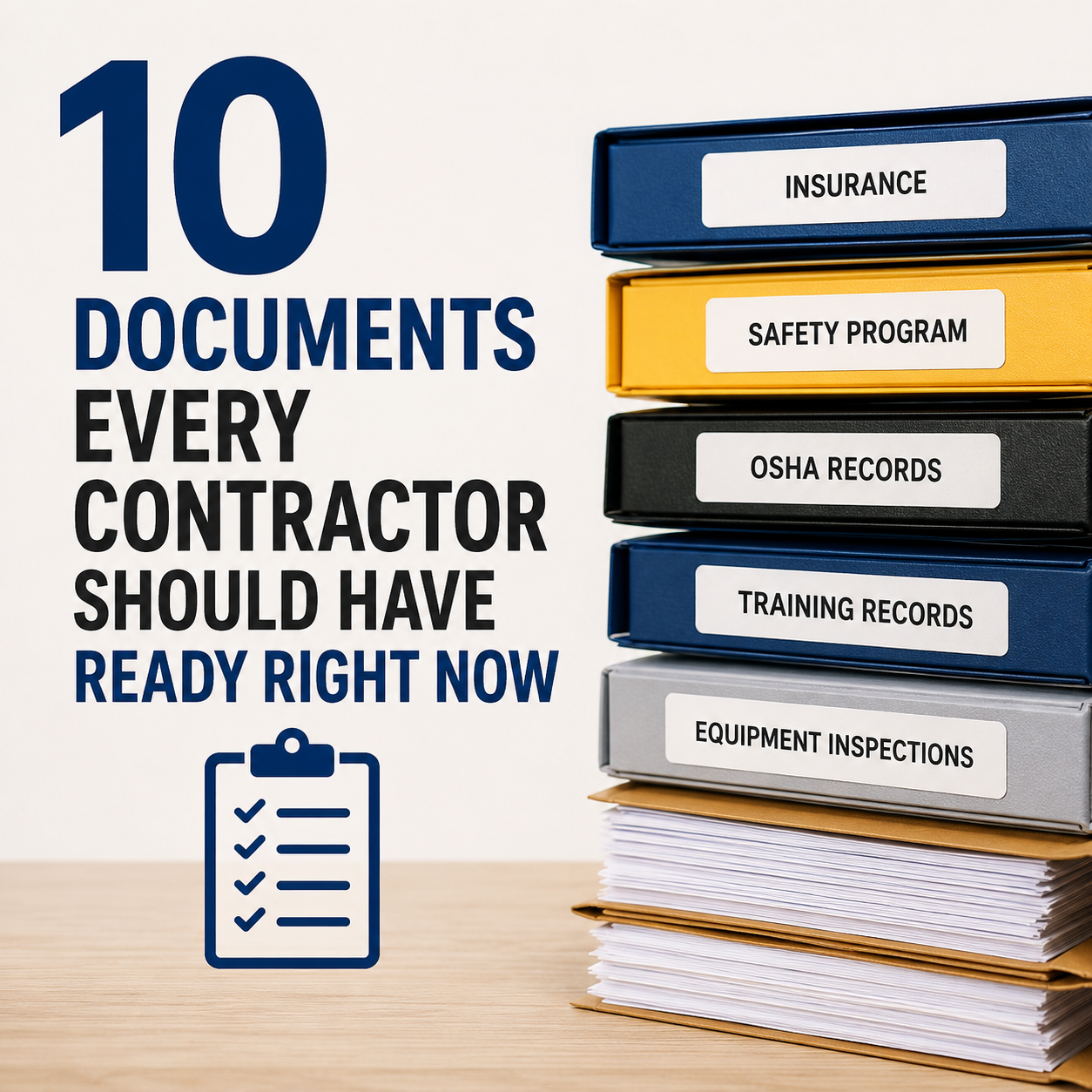
Here are 10 essential documents every contractor should have ready at all times.
Number 1: Written Safety Manual
Your written safety manual is one of the first documents clients and prequalification platforms review. It outlines your company's safety policies, responsibilities, and procedures for protecting employees on the job. A well-maintained safety manual demonstrates that your company has established expectations for workplace safety and regulatory compliance.
Your manual should be reviewed regularly and updated whenever regulations, operations, or company policies change.
Number 2: OSHA 300 Logs and Incident Records
Your OSHA injury and illness records provide insight into your company's safety performance.
Depending on your company's size and industry, clients may request:
- OSHA 300 Log
- OSHA 300A Summary
- OSHA 301 Incident Reports
- And, recordable injury history
Keeping these records accurate and up to date is essential for calculating safety metrics and demonstrating transparency during the prequalification process.
Number 3: Certificate of Insurance (COI)
Insurance documentation is one of the most common reasons contractors experience delays during prequalification.
Your Certificate of Insurance should be current and accurately reflect:
- General liability coverage
- Workers' compensation
- Automobile liability
- Umbrella or excess liability (when required)
- Policy effective dates
- Required limits
- And, correct certificate holder information
Before submitting a COI, verify that it meets the hiring client's specific insurance requirements.
Number 4: Experience Modification Rate (EMR) Letter
Most hiring clients request an official EMR letter from your workers' compensation insurance carrier. This document confirms your company's current EMR and provides an objective measure of your workers' compensation claims history.
Be sure you're submitting the most recent version available, as outdated letters may result in additional review or possible rejection.
Number 5: Employee Training Records
Training documentation helps demonstrate that your workforce is qualified to perform work safely.
Common records may include:
- OSHA training
- Equipment certifications
- Fall protection training
- Confined space training
- Lockout/tagout training
- Respiratory protection training
- And, first aid and CPR certifications
Keeping these records organized allows you to quickly respond to client requests or audits.
Number 6: Written Job Hazard Analyses (JHAs)
Job Hazard Analyses identify potential hazards before work begins and establishes controls to reduce risk.
Many hiring clients expect contractors to perform JHAs for high-risk tasks and may request examples during the prequalification process.
Well-developed JHAs demonstrate that your company actively identifies and manages workplace hazards rather than simply reacting to incidents.
Number 7: Equipment Inspection Records
Regular equipment inspections show that your company is committed to maintaining safe and reliable tools and machinery.
Examples include inspections for:
- Ladders
- Forklifts
- Aerial lifts
- Cranes
- Fire extinguishers
- Personal fall protection equipment
- Or, electrical tools and extension cords
Inspection documentation also helps verify compliance during client audits and jobsite inspections.
Number 8: Emergency Action Plans (EAPs)
Every contractor should have a written Emergency Action Plan that outlines how employees should respond during emergencies.
An effective plan typically includes:
- Evacuation procedures
- Emergency contacts
- Medical response procedures
- Fire response
- Severe weather procedures
- And, reporting requirements
Clients want confidence that contractors are prepared to respond quickly and effectively if an emergency occurs.
Number 9: Substance Abuse and Drug Testing Policy
Many hiring clients require contractors to maintain a written drug and alcohol policy.
Depending on client requirements, supporting documentation may include:
- Written policy
- Pre-employment testing procedures
- Random testing program
- Post-incident testing procedures
- And, reasonable suspicion procedures
Having these documents readily available can help satisfy client-specific compliance requirements.
Number 10: Employee Photos
Make sure you have current, high-quality photos of all employees taken against a plain, neutral background in case a jobsite requires employee ID badges for site access.
Each employee should face the camera directly without wearing hats, sunglasses, or anything else that obscures their face. Avoid full-body photos, as most prequalification platforms and hiring clients require a clear headshot for identification purposes.
Keeping these photos readily available helps your company quickly meet potential ID badge requirements, avoid delays in the prequalification process, and ensure employees can access jobsites without unnecessary interruptions.
Why Staying Audit-Ready Matters
Having these documents organized isn't just about checking boxes, it demonstrates professionalism, preparedness, and a commitment to safety.
When documentation is complete and current, contractors can:
- Complete prequalification applications faster
- Reduce requests for additional information
- Avoid unnecessary compliance delays
- Build confidence with hiring clients
- And, improve their chances of winning new work
Instead of scrambling to gather paperwork every time a client requests information, successful contractors maintain these documents year-round so they're always prepared.
JJ Safety’s Advice
To gain insight into why documentation matters, I asked a JJ Safety employee and JJ Safety’s co-owner the following question:
"In your opinion, why does being prepared with the right documentation set contractors apart from those who aren't?"
Their responses highlight how proper preparation can give contractors a competitive advantage and demonstrate the value of maintaining accurate, up-to-date safety documentation.
Customer Service Manager, John Golay says:
“As a company, being prepared with the right documentation is critical for multiple reasons; First, not having it prevents delays in the bidding process, which means you may not get the job at all. Second, not having it could push back project start dates, which means you can have equipment, employees, sub-contractors, parts and supplies sitting around costing you money. Lastly, it’s your presentation- How you are viewed by clients, potential clients, and even other contractors and suppliers that are on a job with you. Do you want to be viewed as a company that is disorganized, causing delays, looks unsafe and poorly managed? Don’t be “good enough” be “great”!”
JJ Safety’s Co-Owner, John Shelman says:
“Being prepared with the right documentation sets contractors apart because it builds instant trust, proves legal compliance, and prevents costly project delays. The three key benefits are trust and credibility, risk reduction, and faster approvals.”
How JJ Safety Can Help!
At JJ Safety LLC, we specialize in helping contractors manage their compliance and prequalification accounts on leading platforms such as ISNetworld®, Avetta®, Veriforce®, and many others. We also develop customized safety manuals, written safety policies, and safety meetings. Whether you're looking to simplify prequalification or strengthen your safety documentation, our team is here to help.
To learn more about our services, visit our website or call us at 866-627-3850.
Conclusion
Strong safety performance is only part of the equation. Clients also want evidence that your company has effective systems, accurate documentation, and a proactive approach to risk management.
By keeping these 10 essential documents organized and up to date, you'll be better prepared for contractor prequalification, client audits, compliance reviews, and new project opportunities.
Being audit-ready doesn't happen overnight, it's the result of consistent organization and ongoing attention to your safety and compliance program. The contractors who stay prepared are often the ones who secure more work, respond to opportunities faster, and build lasting relationships with clients.

Brooklyn Nice
Brooklyn Nice is a Content Development Specialist at JJ Safety, where she creates engaging, OSHA-focused safety content, training materials, and educational resources for workers and employers. She has earned her OSHA 10 Certification, providing her with a strong foundation in workplace safety principles and industry best practices.